
How Fast Can You Get Portable Toilets After a Disaster in Lansing?
Speed depends on what is blocking the road and how much clearance a delivery truck has. A roll-off or restroom unit needs about 60 feet of straight clearance behind the truck to set down safely, and downed trees or flood debris can eat that space fast. Lansing Porta Pros treats disaster calls as emergency porta potty rental work, which means the dispatch order jumps ahead of routine deliveries. If a shelter or command post is standing up in Lansing within hours, call and describe the site: parking lot, gravel lot, grass field. That single detail decides whether we send a standard unit on standard porta potty rental or a full restroom trailer rental with its own water and holding capacity.
For scattered residential blocks without power or water, a cluster of portable toilet rental units placed at accessible points beats one big trailer nobody can walk to. East Lansing sits 6.2 miles northeast and Meridian 8.4 miles east, both distances we plan around when a disaster response spans more than one municipality and trucks are running back to back routes. OSHA 1926.51(c)(1) sets toilet ratios for organized work crews, and while a disaster site is not a construction job, the same math helps: figure one unit for roughly every 20 responders or displaced people staged at a single point, then add units as the population grows.
What Sanitation Equipment Works Best for a Disaster Site?
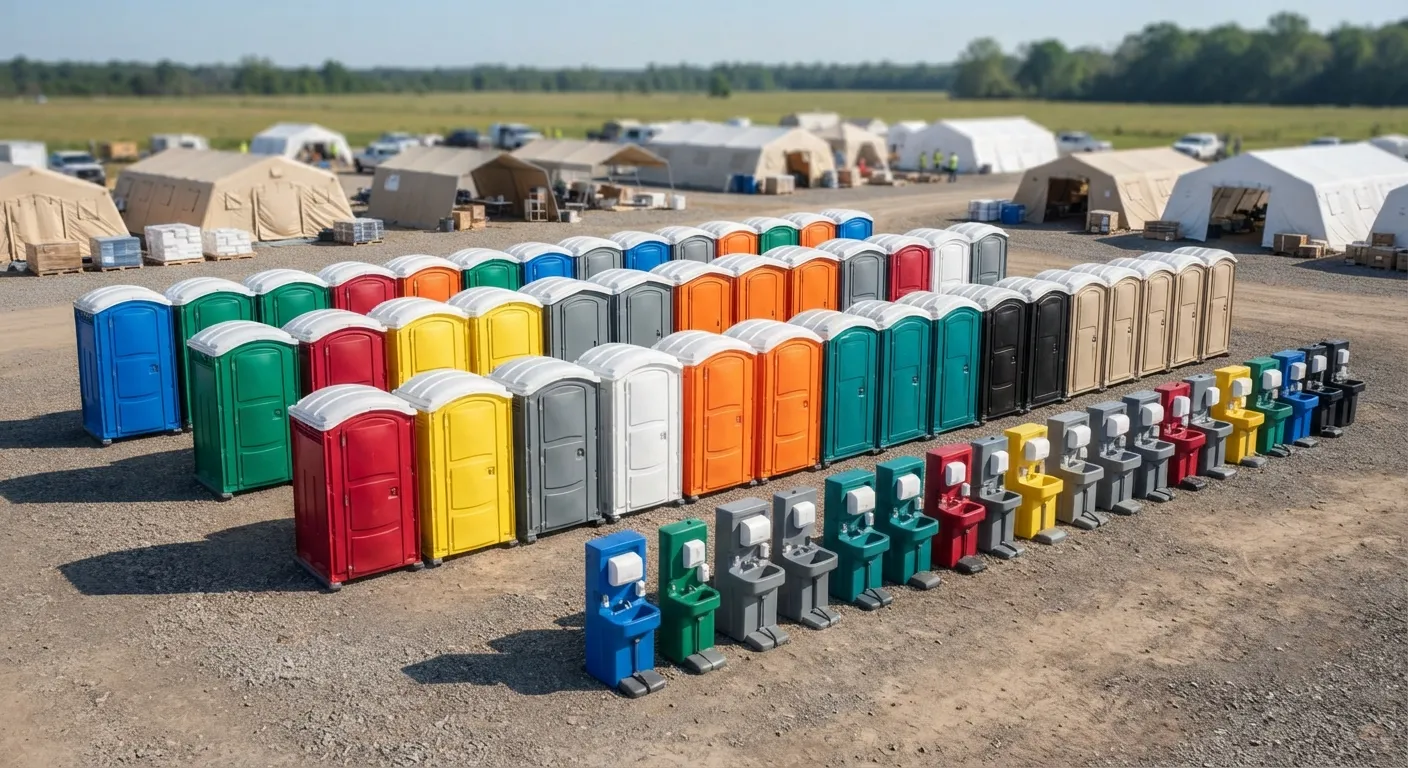
The right mix depends on how long people will be there and whether ground is even solid enough to place a unit. A standard unit runs about 44 by 48 inches on the ground and stands 92 inches tall, small enough to fit on damaged pavement or a gravel shoulder where a trailer cannot go. For a shelter expected to run more than a few days, a restroom trailer rental or a 2 stall restroom trailer gives responders a flush toilet and a sink in one unit, which matters when hand-washing infrastructure is also down citywide.
Water service disruption is common after storms, and that is where a handwashing station rental or portable sink rental fills the gap. Under 29 CFR 1910.141(d)(2), washing facilities need soap and towels or a hand-drying device; hand sanitizer alone does not satisfy that standard, and disaster camps are exactly where people try to skip the step. If cleanup crews are handling chemical spills, coatings or other contaminants from flood damage, OSHA 1926.51(f)(1) requires washing facilities specifically for that exposure, separate from general sanitation.
Debris removal runs alongside sanitation on almost every disaster job. A roll-off dumpster rental clears storm debris and ruined household goods, and a 10 yard dumpster rental or 20 yard dumpster rental usually covers a single flooded home. Larger municipal cleanup often needs a 30 yard dumpster rental or 40 yard dumpster rental staged near a collection point. Check what cannot go in a dumpster before loading, since some storm debris, like propane tanks or certain chemicals, needs separate handling.

What Does Emergency Sanitation Cost During a Disaster?
Pricing during an emergency response follows the same bands as any short-term rental, though weekend and rush delivery carry a premium over a standard weekday order.
| unit | day | week | month |
|---|---|---|---|
| standard | $100-$350 | $130-$500 | $125-$325 |
| ada | $200-$400 | $240-$300 | - |
| dumpster | $51-$112 | $426-$778 | $500-$779 |
Delivery fees run $100 to $500 for a single day dispatch and $50 to $150 for a week-long placement, and a rush weekend delivery can run $125 to $540 depending on distance and how many trucks are already committed. Storage space for donated supplies or equipment staging is worth planning too. A storage container rental or 20ft storage container runs $100 to $250 a month and gives a command post lockable space that a tent cannot. If the disaster site needs to control access, a temporary fence rental at $30 to $75 a day keeps people out of unstable structures. For full cost planning, porta potty rental cost breaks down the same numbers by rental length.
How many portable toilets does a shelter need?
Start with one unit per 20 people, the same ratio OSHA 1926.51(c)(1) uses for construction crews, then adjust upward once the population is confirmed. See how many porta potties do I need for the full breakdown by headcount and hours of operation.
Can you deliver to a flooded or damaged property?
Often, yes, if there is 60 feet of clearance behind where the truck needs to park. Downed lines or standing water can block delivery. Call ahead and describe ground conditions so Lansing Porta Pros can route the right truck and confirm emergency septic service if a tank was also compromised.
Do you provide ADA accessible units for shelters?
Yes. ADA Standards section 213.2 requires at least one accessible unit in any cluster of single-user toilets, and never fewer than one. See ADA accessible porta potty for unit specs and placement needs.
What if our septic system failed during the disaster?
A failed tank needs pumping before it can be used again, and septic pumping service covers emergency calls. Watch for the signs listed at septic tank warning signs before assuming the system is safe to use.
How long can disaster relief rentals stay on site?
As long as needed. Many disaster placements run weeks or months rather than days, and monthly porta potty rental pricing applies once a placement passes the short-term window.
Next step
Get a delivery date
Tell us the address, the dates and the headcount. We size the order and confirm the route.